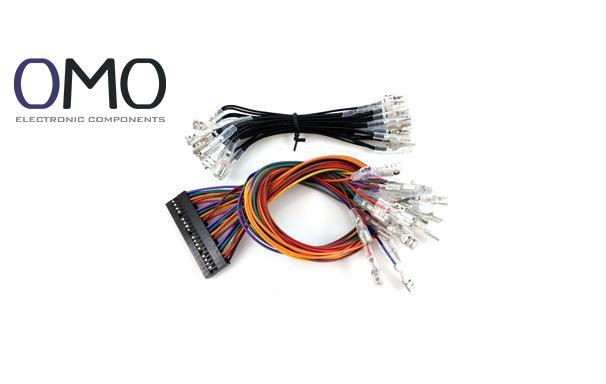
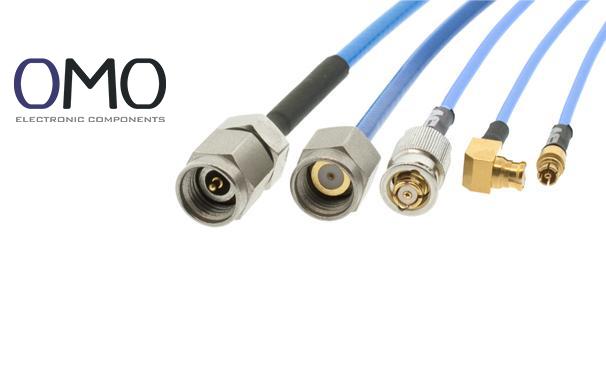
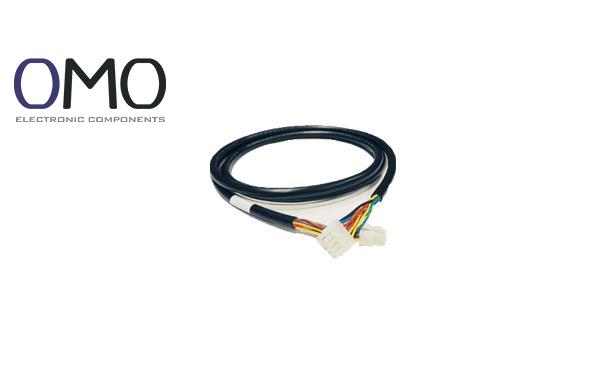
A Cable Assembly is a finished unit. It is made by integrating many wires or cables, connectors, terminals, and other external parts (such as sheath, strain relief, etc.). It is a complete plug-and-play solution for power or signal transmission.
Unlike a simple wire harness, a cable assembly is fully assembled and tested in the factory. Users can install it directly without extra processing.
Main Features
The main features of a cable assembly are:
Integration: It combines wires, connectors, and sheaths into one unit. This reduces the number of separate parts in the system.
Customization: It can be designed for special size, length, electrical and mechanical needs. It offers a highly matched solution.
Reliability: It is assembled and tested under strict control in a factory. This ensures stable and consistent performance.
Easy Installation: It works as a plug-and-play unit. It saves time during on-site wiring and reduces human errors.
Core Parts and Main Components
A typical cable assembly has several key parts. Each part has an important role:
Wire/Cable: The main conductor to carry power or signals. Common materials are copper or optical fiber.
Connector: The pluggable interface, such as RJ45, USB, D-Sub, HDMI.
Terminal: The connection point between wire and connector. It is fixed by crimping or soldering.
Outer Sheath: It protects inner parts with insulation and strain relief. Materials can be corrugated tube, braided net, or heat-shrink tube.
Other Accessories: Such as cable clamp, label, or shielding layer. They improve organization, identification, and anti-interference ability.
HS Code
In international trade, cable assemblies are classified by material and function. Common HS (Harmonized System) codes include:
8544.42: Cables with connectors, voltage not over 80 volts.
8544.49: Other cables with connectors not listed.
8517.70: Parts for telecom equipment, sometimes including cable assemblies.
Note: The exact HS code depends on product details, working voltage, and end use. The above are only examples.
Functions of a Cable Assembly
A cable assembly does more than connect. It is a key part for efficient and reliable operation in modern electronic and electrical systems.
Its main functions are:
Power Transmission: To provide safe and stable power for devices.
Signal Transmission: To carry data, audio, and video signals with accuracy.
Interconnection: To connect modules or devices inside a system and make them work together.
Protection: With shielding and sheath design, it protects against EMI (Electromagnetic Interference), RFI (Radio Frequency Interference), moisture, wear, and extreme temperature.
Types of Cable Assemblies
Cable assemblies are divided by medium or application. Different types meet different performance and environment needs.
By Transmission Medium
Copper Cable Assembly: Uses metal conductor for power or signals, such as USB cable, Ethernet cable, coaxial cable.
Fiber Optic Assembly: Uses optical fiber for light signals. It has high bandwidth and strong anti-interference, such as LC-LC patch cord, MPO trunk cable.
By Application
Data Communication: For servers and storage devices, such as SATA, SAS, Infiniband cables.
Industrial: For harsh environments, such as control cables, sensor cables, servo motor cables.
Medical: Uses biocompatible materials (USP Class VI). For MRI, patient monitor, medical imaging.
Automotive: For vibration and temperature changes, such as car entertainment system cables, ECU cables.
Military/Aerospace: High reliability and wide temperature range, for extreme environments.
Key Parameters of Cable Assemblies
Choosing the right cable assembly needs several key parameters:
Category
Parameter
Description and Impact
Conductor
Size (AWG), material
Decides current capacity and resistance. Smaller AWG = larger current.
Insulation & Sheath
Material (PVC, PUR, TPE)
Affects flexibility, temperature resistance, oil and chemical resistance.
Electrical
Voltage/current rating, impedance
Ensures safe operation and system matching. Impedance is key for high-frequency signals.
Shielding
Type (braid, foil)
Protects against EMI and RFI. Higher braid coverage = better effect.
Mechanical
Bend radius, durability
Good flexibility and durability extend life in dynamic use.
Environment
Temperature range
Ensures stable work under high/low temperature.
Compliance
Certifications (UL, CE, RoHS)
Proves product meets safety and environmental standards.
Applications of Cable Assemblies
Cable assemblies are used in almost all electronic and electrical fields:
IT & Telecom: In data centers, they connect servers, storage, and switches. One cabinet may use hundreds of cables, affecting throughput and stability.
Industrial Automation: On production lines, they connect PLC, robots, servo drivers, sensors. Failures affect OEE (Overall Equipment Effectiveness).
Medical Devices: For MRI, CT, patient monitors, and surgical tools. They need accurate signals and biocompatibility.
Consumer Electronics: Everywhere in daily life, like phone chargers, headphone cables, home appliance wiring.
Automotive Electronics: In infotainment, ADAS (Advanced Driver Assistance System), and control systems. Their quality affects safety and user experience.
Energy: In solar and wind power, they connect inverters, controllers, and monitors. Weather-resistant design ensures stable green energy.
Main Differences: Cable Assembly vs Wire Harne
Feature
Cable Assembly
Wire Harness
Outer Protection
Full sheath, shielding, EMI/RFI protection.
Tied by tape or tube, no full sheath.
Environment
Works in harsh or outside conditions.
Works inside equipment or vehicles.
Complexity
Can include power, signal, coax, fiber, multi-pin connectors.
Mainly simple wires for power and signal.
Customization & Cost
Very high customization, higher design and cost.
High customization in layout, lower cost.
Steps to Assemble a Cable Assembly
High-quality cable assemblies are made through strict steps:
Cutting and Stripping: Cut cable to length and strip ends to show conductor.
Conductor Preparation: Twist strands or tin wires to prevent oxidation.
Crimping Terminals: Use crimping machines to attach terminals.
Connector Assembly: Insert wires into connector housing or solder to PCB connector.
Mechanical Requirements: Check bend radius, flexibility, wear resistance, shock and bend resistance.
Environment Factors: Check temperature range, chemical, oil, UV, humidity exposure. Choose right sheath and insulation.
Compliance & Certification: Make sure it meets market standards, such as UL (North America), CE (Europe), RoHS (hazardous substance restriction).
Frequently Asked Questions
What is a cable assembly?
A cable assembly is a composite structure of multiple wires or cables that are often fitted with connectors. It is typically sheathed in a protective covering for insulation and shielding, engineered to facilitate the transfer of electrical signals or power in electronic and electrical systems.
What is cable harness assembly?
The process of cable harness assembly involves bundling and routing multiple electrical wires, cables, and connectors into a unified structure. Its primary function is to ensure reliable connectivity for the transmission of signal or power across electrical components.
What does a cable assembler do?
The role of a cable assembler involves building and testing electrical cable assemblies by cutting, stripping, and joining wires; attaching connectors; and then organizing them into harnesses or bundles.
What are the three main parts of a cable?
A cable is typically composed of three essential parts: a central conductor for transmitting electrical signals or power, an insulating layer that encases this conductor, and an outer protective sheath that ensures durability and overall protection.