A two-way switch is a special electrical control device. It allows the user to control the same lamp or appliance from two different places. This design breaks the space limits of the traditional one-way switch. It gives homes and businesses more flexible lighting control.
In North America, it is often called a three-way switch. The name comes from its wiring method, which needs three wires to connect two switches. Whether in a villa staircase or a long corridor, the two-way switch improves function and user experience.
Definition and Basic Idea
A two-way switch is a circuit system that uses two switches to control one lamp. It is not a single switch, but a control system made of two special switches.
Each switch can change the path of the circuit. This means both control points can work independently. The design is not the same as a simple parallel circuit or series circuit. It uses special wiring logic to give true two-way control.
A working two-way switch system must include three things:
Two special switches
One controlled lamp (the load)
A network of connecting wires
The two switches work together to create more control points. This system is the basic form of multi-point control. It is also the foundation for more complex systems, such as three-way control (control from three places).
Working Principle Explained
The core idea of a two-way switch is smart path switching. The system uses two “traveler wires” (also called strap wires) to build a path between the switches.
When the user flips a switch, it changes the direction of the electric current. Inside each switch is a moving contact. It can connect to one of two fixed contacts. This action guides current to different paths and then to the lamp.
From an electrical engineering point of view, the system works like a simple logic circuit. Every switch action changes the system’s state:
If the lamp is OFF, using any switch will close the circuit and turn it ON.
If the lamp is ON, using any switch will open the circuit and turn it OFF.
This symmetric logic gives both switches equal control power. There is no “main” switch or “slave” switch.
Key Components
A complete two-way switch system has four parts:
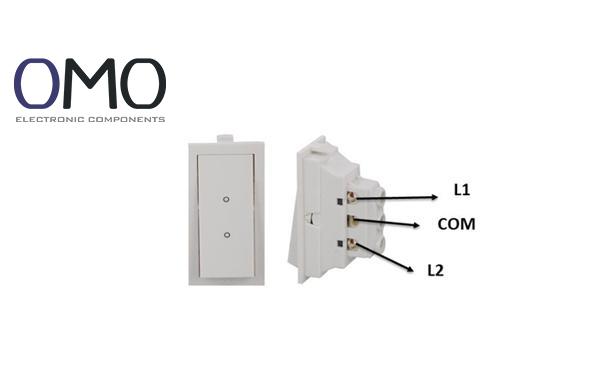
Two special switches: Each switch has three terminals – COM (common terminal), L1, and L2.
Lighting load: Usually a lamp, but it can also be another device.
Power system: Includes live wire (hot wire), neutral wire, and ground wire.
Connecting wires: Especially the two traveler wires between the switches.
Connection works like this:
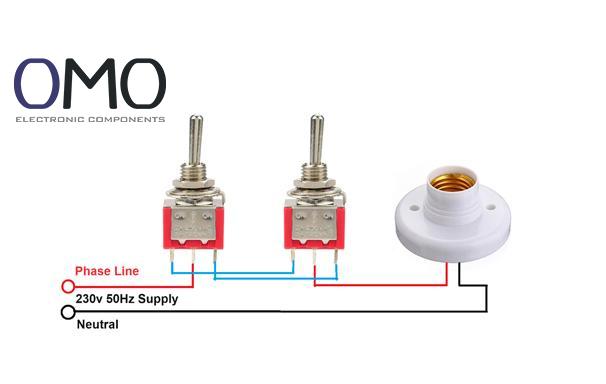
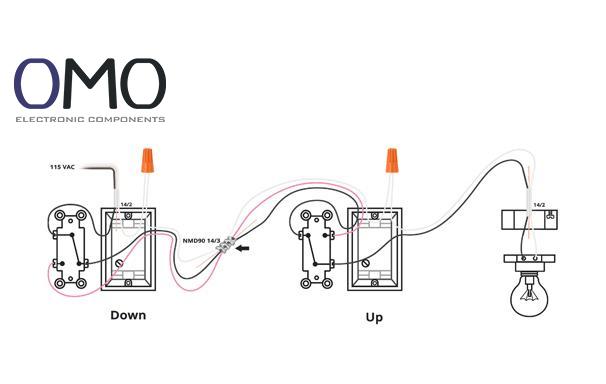
The power live wire goes into the COM terminal of the first switch.
The lamp connects to the COM terminal of the second switch.
L1 and L2 of the two switches connect to each other through traveler wires.
This creates two possible current paths. Switching changes between them.
Main Features
The two-way switch has these features:
Multi-point control: Control one lamp from two locations.
Flexible operation: Choose the most convenient point.
Complex wiring: Needs more wires than a one-way switch.
Symmetric design: Both switches have equal control.
These features make it perfect for places where lighting needs control from more than one position. But installation and maintenance are more difficult.
Two-Way vs One-Way Switch
Control Point Comparison
The key difference is the number of control points.
A one-way switch has one control point. You must operate it at its fixed place.
A two-way switch has two equal control points. You can use either one.
For example, in a long corridor:
With a one-way switch, you must go back to the entrance to turn off the light.
With a two-way switch, you can turn it off at the other end.
This improves convenience and saves unnecessary movement.
Feature Comparison
Feature
One-Way Switch
Two-Way Switch
Control points
1
2
Terminals
2 (L, L1)
3 (COM, L1, L2)
Wires needed
2 (live, neutral)
At least 3 (extra traveler wires)
Installation
Simple
Medium
Best use
Single control area
Multi-point control area
Applications of Two-Way Switch
Home Use
Bedroom: One switch at the door, one near the bed. Turn on when entering, turn off before sleep.
Stairs in villas: One switch at the bottom, one at the top. Safer and easier when moving between floors.
Long corridor: One switch at each end. No need to walk back to turn off the light.
Commercial and Public Use
Office corridors: Control lights at different entrances.
Meeting rooms with many doors: Any door can control the lights.
Warehouses: Workers turn on lights when entering, off when leaving another way. More efficient and safe.
Special Environments
Underground garages: Control lights from stairway and inside the garage.
Attics and basements: Safer with two control points.
Homes for the elderly: Reduces walking distance in the dark, lowers fall risk.
Hospitals and care centers: Improves safety and comfort.
Outdoor paths and gardens: Switch inside the house and another outside for easy lighting control.
Steps to Connect a Two-Way Switch
Safety First
Cut off power at the breaker box.
Use a voltage tester to confirm no power.
Prepare tools: two two-way switches, suitable cables (three-core cable for traveler wires), wire stripper, screwdriver, and connectors (like wire nuts or Wago connectors).
Plan switch positions, lamp position, and cable routes.
Wiring Steps
Connect the live wire to COM of the first switch.
Use two traveler wires to connect L1 to L1 and L2 to L2 between the two switches.
Connect COM of the second switch to the lamp’s live input.
Connect the lamp’s neutral wire directly to the power neutral wire.
Connect all ground wires safely
This forms a complete circuit. Current flows from power → switch 1 → traveler wires → switch 2 → lamp → neutral.
Testing
Check all connections are tight and safe.
Restore power and test:
Operate switch 1.
Operate switch 2.
Try alternating both.
If the lamp does not work correctly, cut power and check wiring again.
Advantages of Two-Way Switch
Convenience and Comfort
No need to walk long distances to control lights.
Saves time and energy.
Bedroom: switch at bed gives comfort.
Stairs and corridors: smooth lighting control.
Helps people with limited movement.
Energy and Cost Benefits
Easier to switch off lights, so people save energy.
Saves electricity bills.
Extends lamp life by reducing working hours.
Higher installation cost, but long-term savings.
Safety and Risk Reduction
Safer in dark areas like stairs and corridors.
Extra safety in emergencies: any exit can control lights.
Better for homes with children or elderly.
Prevents accidents during night movement.
Detailed Installation Guide
Tools and Materials
Two quality two-way switches
Three-core cable for traveler connection
Two-core cable for power and lamp
Cable clamps or trunking
Junction box or wall box
Insulating gloves and safety glasses
Make sure all cables meet safety standards. Use reliable, certified switches.
Standard Wiring Explanation
State 1 (Lamp OFF): Current reaches switch 1 COM but does not pass to traveler wires → lamp stays OFF.
State 2 (Lamp ON): Switching action connects COM → traveler wires → COM of switch 2 → lamp → neutral → lamp ON.
State 3 (Lamp OFF again): Any switch action breaks the path → lamp OFF.
Traveler wires must connect correctly: L1 to L1, L2 to L2. Wrong connections stop the system from working.
Safety Notes
Always cut and test power before work.
Fix all connections tightly.
Correctly identify live, neutral, and ground wires (follow local color codes).
Use correct cable size.
Inspect all connections before powering.
During first test, be ready to cut power immediately if needed.
Frequently Asked Questions
What is the difference between a 2 way switch and a 3-way switch?
A two-way switch operates a light from a single point, utilizing two terminals (a common and one traveler). In contrast, a three-way switch allows control from two different locations, requiring three terminals (a common and two travelers) and must be used in pairs.
How many terminals does a two-way switch have?
A two-way switch features three terminals: namely, a common (COM) along with two traveler terminals (L1 and L2).
Can I use a 3 way switch for a 2 way light?
It is possible to employ a 3-way switch for a 2-way lighting setup. This is done by using only two of the three available terminals on the switch, effectively wiring it as a standard single-pole switch.
What is the difference between a 1 way switch and a 2-way switch?
A single-pole (1-way) switch operates a light from one point, utilizing two terminals: one common and one output. In contrast, a two-way (3-way) switch enables control of the same light from two separate locations, and requires three terminals: one common and two travelers.